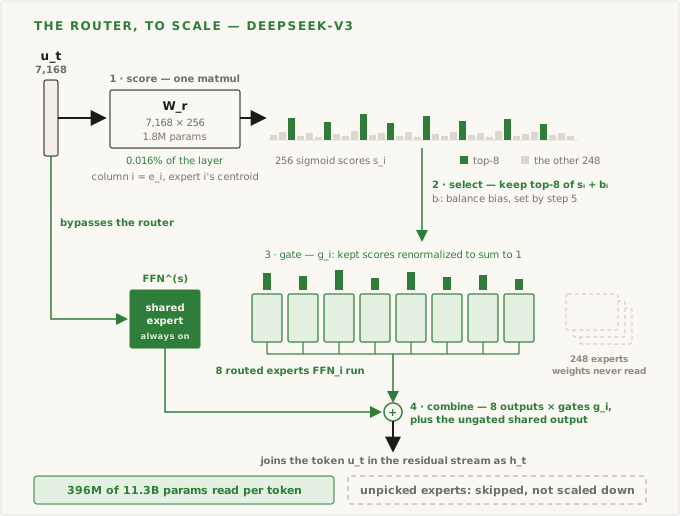
The router in DeepSeek-V3 is a 7,168 × 256 matrix — about 1.8M parameters, 0.016% of the 11.3B-parameter mixture-of-experts (MoE) layer it controls. For every token, at every one of 58 MoE layers, that matrix decides which 8 of 256 routed experts run — a ninth, shared expert always does: 396M parameters read, 10.9B untouched. The cheapest component in the model controls the most expensive one. That inversion is the whole bet MoE makes: per-token compute stays fixed while total capacity scales — all the way to V4-Pro’s 1.6T parameters on the shelf, 49B per token.
The previous post, on the multilayer perceptron (MLP), ended with the MoE layer in one paragraph — a router scores the token, keeps the top k, sums the winners. These are my notes from opening that paragraph up. The recipe, up front — what runs for every token at every MoE layer, in V3’s numbers (the frontier varies the counts, not the steps):
- Score — one matmul: 256 affinities per token.
- Select — keep the top 8 of score + bias.
- Gate — renormalize the winners’ raw scores.
- Combine — experts, shared expert, and the token, summed.
- Rebalance (training only) — nudge the bias, outside the optimizer.
Steps 1–4 are token-choice routing — each token picks its experts. Step 5 keeps it from collapsing, and getting that step down to one line took the field from 2017 to 2024.
The recipe in full: one matmul, a sort, and a nudge
That is DeepSeek-V3’s MoE layer, complete — the one thing the equation compresses is that ranks biased scores, , and step 2 spells that out.
The fixed parts first. is the token’s residual-stream vector, 7,168 wide; is what the layer writes back. Each routed expert is a small SwiGLU (Swish-gated linear unit) with the same structure as the MLP post’s, 2,048 wide instead of the 18,432 a dense MLP mirroring V3’s width would use; is the shared expert, fed straight from , bypassing the router. (FFN — feed-forward network — is the papers’ name for the MLP block.)
The small width is the shape decision, and no frontier model has reversed it since 2024. Mixtral 8x7B gave its router 8 experts and took 2, for 28 possible combinations per token; DeepSeekMoE (Jan 2024) made the case for cutting experts smaller and taking more of them at the same FLOPs. The ladder is steep: the paper’s worked example starts at 16 experts, take 2 — 120 combinations; split each expert into four — 64 experts, top-2 becomes top-8 to hold FLOPs constant — and 64-choose-8 gives 4.4 billion; V3’s 256-choose-8 is ~4 × 10¹⁴, at the same FLOPs on every rung. A scaling-law study of expert granularity landed on the same side: “the common practice of setting the size of experts in MoE to mirror the feed-forward layer is not optimal at almost any computational budget.”
1 — Score
One matmul turns the token into 256 numbers: , one score per expert. is column of the 7,168 × 256 router matrix — one 7,168-wide vector per expert, which the paper calls its centroid — and the dot product measures how well the token matches it. is the sigmoid, : it maps each dot product into independently, so expert ’s score does not depend on expert ’s.
Why sigmoid, not softmax. Softmax — the alternative, and DeepSeek-V2’s choice — couples all 256 scores into one distribution summing to 1.
2 — Select
Add a per-expert bias to each score and keep the 8 highest — 256 candidates become 8 experts, and the bias exists only for this comparison.
The comparison that decides who gets picked uses ; the gate that decides how much a picked expert contributes still comes from the raw — the above is the pre-normalization gate, which step 3 renormalizes. Selection is all-or-nothing, not a soft weighting: the 248 unpicked experts are not scaled down toward zero — they are skipped, their weights never read. (The serving section prices that skipping.) The bias itself is set by step 5, not by training.
Why token-choice, not expert choice. A router with exact balance has existed since 2022, and essentially no decoder-only LLM uses it: expert choice routing (Zhou et al., NeurIPS 2022) inverts the assignment — each expert picks its top- tokens from the batch — so every expert takes exactly tokens by construction. The flaw is one sentence in its own limitations section: the top- runs across the token dimension, so it “takes in the past and future tokens” — a future-information leak at training time, and at decode time the future tokens don’t exist yet, so the router is unrunnable as specified. That single property keeps the guaranteed-balance router out of Mixtral, DeepSeek, Qwen, and every other autoregressive frontier model.
3 — Gate
— each kept score divided by their sum, so the 8 gates sum to 1 and an expert that scored twice as high contributes twice as much. The input is the raw , not the biased score. The renormalization is the price of step 1’s independence: sigmoid scores do not sum to anything in particular, and one division settles it.
4 — Combine
Sum the 8 gated expert outputs, the shared expert’s output, and the token itself into . The score has now entered the output twice — step 2 decided which experts appear in the sum, step 3 decided how much each counts.
The shared expert in that sum is DeepSeekMoE’s second move: one FFN kept always on to hold what the paper calls common knowledge, so 256 specialists don’t each relearn it. It is a recipe, not a law — OLMoE’s ablation measured no gain from sharing, Qwen3 excluded it, and Qwen3.5 reintroduced one shared expert on top of 512 routed — but the shared-expert column in the frontier table below mostly reads “+ 1”.
Why it matters that the gate is in the sum. The gate is the router’s only gradient path: backpropagation reaches only through the gates of selected experts. Picked experts train; unpicked experts don’t — hold that thought for step 5.
5 — Rebalance (training only)
DeepSeek-V3 balances 256 experts with a number the optimizer never updates: after each training step, overloaded experts get their bias nudged down by and underloaded experts up, with . No gradient — a feedback loop shifting selection toward underloaded experts, running beside the optimizer. The loop is training-only: at inference, selection runs on the frozen .
Why the step exists. Left alone, the router self-reinforces: a picked expert gets gradient updates and improves; an improved expert scores higher and gets picked more; the unpicked majority never learns and never recovers. The literature calls the end state routing collapse — OLMoE reports that without a balancing mechanism, “all tokens in the first layer are assigned to the 6th expert.”
Why a bias, not a loss. From 2017 to 2024 the standard fix was an auxiliary loss — Switch Transformer’s is the canonical form — a differentiable penalty that rewards uniform routing, tuned just large enough to balance without overwhelming the cross-entropy objective; the era also capped each expert’s intake, so a token whose experts’ buffers were all full skipped the layer, passing through the residual connection untransformed (“token dropping”). The deeper cost wasn’t the dropped tokens, it was interference: the balancing gradient is not the language-modeling gradient.
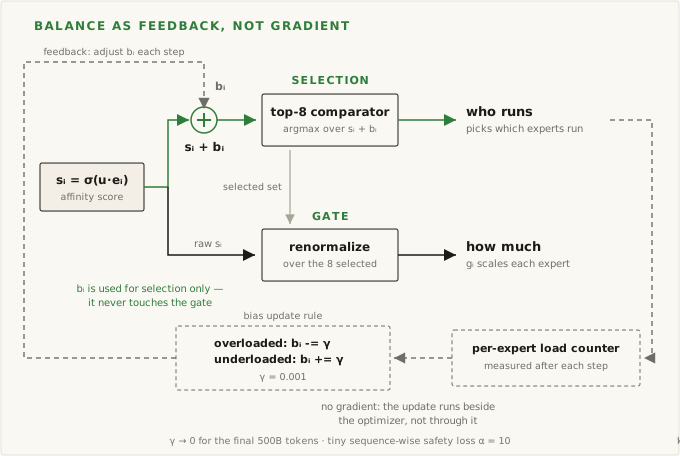
The method paper calls it auxiliary-loss-free load balancing (Wang et al., 2024) and reports it beats aux-loss training on both balance and perplexity — validated at 3B parameters and 200B tokens before V3 bet 14.8T tokens on it. Net effect: no token dropping, in training or inference.
One footnote to “loss-free”: V3 keeps one auxiliary term, a sequence-wise balance loss against extreme imbalance within any single sequence, at — “extremely small.” That per-sequence pressure has a measurable cost; the specialization findings below come back to it.
Then everyone took it — sigmoid affinity plus a selection-only bias is the frontier’s default router, and the config files in the frontier section below have the receipts.
What experts learn: syntax, not subjects
Mostly not domains. Mixtral’s authors went looking for topic specialization in their own model and reported the null result: “we do not observe obvious patterns in the assignment of experts based on the topic.” What does drive assignment is syntax and position: self in Python and indentation tokens hit the same experts consistently, and consecutive tokens repeat their first-choice expert at roughly twice the random rate in deeper layers.
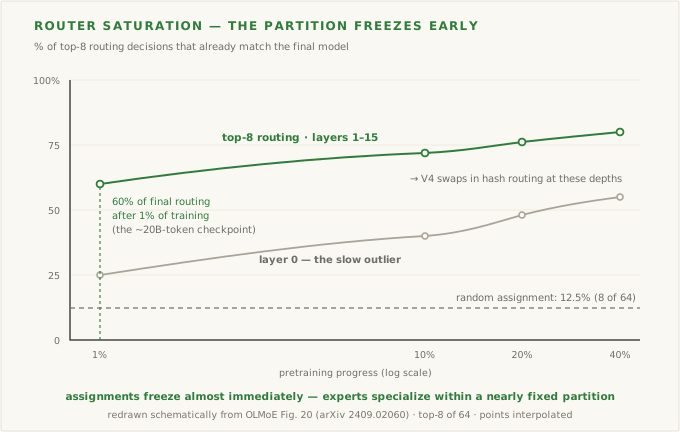
The most striking router fact I ran into is router saturation: after what the paper calls the 1% checkpoint — 5,000 steps, ~20B of its 5T training tokens — up to ~60% of routing decisions already match the final model. That measurement is OLMoE’s — fully open weights, data, and logs, and a model that did show more measurable vocabulary and domain specialization. The experts spend the remaining 99% of training specializing into a nearly frozen partition.
The 2026 interpretability round (two preprints: routing-as-geometry, a domain-invariant “standing committee” of experts) points the same way: an “expert” is a shard of MLP capacity the router’s geometry favors, not a subject specialist. The actionable finding is Qwen’s “Demons in the Detail”: computing the balance loss per micro-batch forces every sequence to spread across all experts, suppressing domain specialization — the per-sequence pressure step 5’s footnote flagged. Moving the loss to the global batch improved perplexity and specialization together. That global-batch loss is what Qwen3 ships in the frontier table below.
The frontier: what mid-2026 ships
Mid-2026 mostly ships one recipe: DeepSeek-V3’s. Eleven configs side by side:
| Model | Shipped | Total → active | Experts (routed + shared) | Top-k | Score | Balance |
|---|---|---|---|---|---|---|
| Mixtral 8x7B | 2023-12 | 47B → 13B | 8 + 0 | 2 | softmax | — |
| DeepSeek-V3 | 2024-12 | 671B → 37B | 256 + 1 | 8 | sigmoid | bias (aux-loss-free) |
| Llama 4 Maverick | 2025-04 | 400B → 17B | 128 + 1 | 1 | — | — |
| Qwen3-235B-A22B | 2025-04 | 235B → 22B | 128 + 0 | 8 | softmax | global-batch aux loss |
| gpt-oss-120b | 2025-08 | 117B → 5.1B | 128 + 0 | 4 | softmax | — |
| Qwen3.5-397B-A17B | 2026-02 | 397B → 17B | 512 + 1 | 10 | — | — |
| Kimi K2.6 | 2026-04 | 1T → 32B | 384 + 1 | 8 | sigmoid | bias |
| DeepSeek-V4-Pro | 2026-04 | 1.6T → 49B | 384 + 1 | 6 | sqrtsoftplus | bias + early hash layers |
| DeepSeek-V4-Flash | 2026-04 | 284B → 13B | 256 + 1 | 6 | sqrtsoftplus | bias + early hash layers |
| GLM-5.2 | 2026-06 | 753B → 40B | 256 + 1 | 8 | sigmoid | bias |
| MiniMax-M3 | 2026-06 | 428B → 23B | 128 + 1 | 4 | sigmoid | bias |
A “—” means the lab hasn’t published that detail.
Three things I read off this table.
The convergence. The V3 recipe, in full: sigmoid scores, selection-only bias, one shared expert, fine-grained experts around width 2,048, and a few dense layers at the bottom of the stack — ordinary always-on MLPs, no router. The adoption is visible in the config files: GLM-5.2’s MoE config is nearly V3’s, field for field, shipping topk_method: "noaux_tc" — DeepSeek’s own field name for the bias mechanism — with sigmoid scoring; Kimi K2 trained 1T parameters with the same recipe, and K2.6 carries it forward; MiniMax-M3’s config enables the router bias with sigmoid scores.
The departures. Small but deliberate. DeepSeek-V4 picks its third score function — the tech report changes “the activation function that computes the affinity scores from Sigmoid(·) into Sqrt(Softplus(·))” (scoring_func: "sqrtsoftplus"), after V2’s softmax and V3’s sigmoid — and replaces the early dense layers with MoE layers routed by a hash of the token ID: no learned router at the depths where learned routing seems to have the least to add, consistent with OLMoE’s saturation data (V4-Flash’s config counts three such layers). One caveat: the report calls itself a preview of the V4 series, so these numbers may move.
Two models sit outside the recipe entirely. Llama 4 Maverick went the other direction — top-1 routing, MoE in only half its layers, and no tech report. gpt-oss-120b is the minimal design — the Switch lineage, shipped by OpenAI in 2025.
The falling ratios. Total capacity is scaling much faster than per-token compute — the trade-off MoE is designed to make, taken further every generation. V3 activated 5.5% of itself per token; V4-Pro is 2.4× larger in total (671B → 1.6T) but activates 3.1%; Kimi K2.6 runs at 3.2%, and the top-k went down at DeepSeek, 8 to 6.
Serving: sparsity pays at scale
An MoE has the compute profile of its active parameters and the memory profile of its total. DeepSeek-V3 does 37B parameters of matmul per token, but all 671 GB of FP8 weights must sit in HBM (high-bandwidth memory) before the first request arrives — SGLang’s minimum serving config is eight H200-class GPUs.
The router subdivides the MLP post’s memory-bound GEMV (general matrix–vector product) problem rather than solving it: with batch and top- of experts, each expert sees about tokens — for V3, . A batch of 128 hands each expert ~4 tokens, for which it still streams all 44M of its parameters from HBM; one third-party analysis puts the critical batch size where an H100 stops being bandwidth-bound near 300 tokens. That is the shape of the trade: the sparsity that cuts per-token compute raises the batch size at which the cut pays for itself.
At scale, the standard approach is expert parallelism (EP): experts are spread across GPUs (DeepSeek’s production system ran prefill at EP32 and decode at EP144 — 18 nodes just for decode), and every token is dispatched to its experts’ GPUs and back at each layer. Each layer’s dispatch-and-combine is a barrier, so one overloaded expert stalls the entire cluster — and imbalance is what happens in practice: the same skew the bias term fights during training, resurfacing at decode time. SGLang measured 2.54× decode throughput at 96-H100 scale from duplicating overloaded experts alone (author-reported).
At the single-GPU end, gpt-oss-120b applies quantization by the same arithmetic: experts are 90+% of an MoE’s parameters, so MXFP4 on the expert weights alone (a 4-bit block-scaled float, ~4.25 bits/weight) fits 117B parameters in one 80 GB GPU. The serving side of this trade is a post of its own.
The router decides what runs
One matmul and a sort decide which copies of the transformer’s biggest block run. Keeping that decision balanced went from seven years of auxiliary losses to a bias nudged by ±0.001 — a recipe now written into the frontier’s config files. The router itself learns less than the name suggests — syntax, position, geometry, largely set in the first 1% of training — and the arithmetic doesn’t care: every generation widens the gap between what the model holds and what a token touches. The MLP post weighed the block; this one chose which of its copies run. More notes as I go.